The conversation around hybrid working trends has shifted from if to how. What does “typical” actually look like now—and is there even such a thing anymore?
Insights from our latest 2025 Salary & Benefits Survey reveal a workplace undergoing a permanent transformation. Traditional structures are fading, replaced by flexible, employee-driven models that prioritise productivity, wellbeing, and balance.
The New Reality of Working Patterns
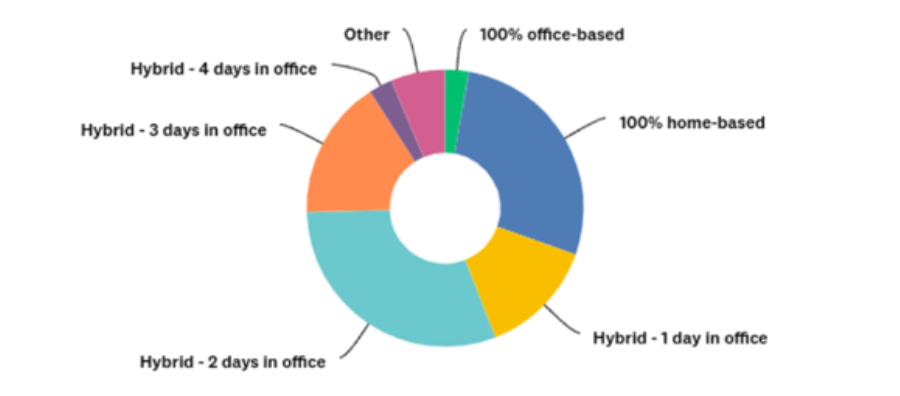
Our data highlights a clear and continued move towards flexibility:
- 📍 30% work hybrid with 2 days in the office
- 🏡 28% are fully home-based
- 📍 16% follow a 3-day office hybrid model
- 📍 14% work 1 day in the office
What’s particularly telling is the growing number of respondents who describe their working pattern as:
- “Varies week to week”
- “1–2 days per month”
- “Flexible depending on workload”
This reinforces a key takeaway in hybrid working trends: rigid structures are being replaced by adaptable, fluid approaches tailored to both business needs and individual preferences.
Why Flexibility Is Now Non-Negotiable
Flexibility is no longer viewed as a perk—it’s an expectation. Employees increasingly prioritise roles that offer autonomy over where and how they work.
There are clear business benefits driving this shift:
✔️ Increased Productivity
Employees working in hybrid or remote models often report higher levels of focus and efficiency. Without the constraints of rigid schedules or long commutes, many are better positioned to deliver results.
✔️ Reduced Burnout
Flexible working plays a significant role in improving work-life balance. This contributes directly to lower stress levels and higher long-term engagement.
✔️ Stronger DE&I Outcomes
Flexible working supports a more inclusive workforce. It enables organisations to attract and retain talent from broader demographics, including those with caregiving responsibilities or accessibility needs.
These factors explain why hybrid working trends continue to dominate conversations across HR, talent acquisition, and business leadership.
The Challenges That Still Remain
While the advantages are clear, hybrid and remote working are not without their challenges.
Two key concerns consistently emerge:
⚠️ Isolation and Connection
Remote working can lead to feelings of disconnection, particularly for those who thrive in collaborative environments. Maintaining team cohesion requires intentional effort.
⚠️ Visibility and Career Progression
Employees working remotely may worry about reduced visibility when it comes to promotions or career development opportunities. This highlights the need for fair and transparent performance frameworks.
Organisations that recognise and actively address these challenges will be better positioned to succeed in the evolving world of work.
Why Hybrid Models Continue to Lead
Despite the rise of fully remote roles, hybrid working remains the most popular and sustainable model.
Why?
Because it strikes the right balance.
Hybrid working combines:
- 🏡 The focus and flexibility of home working
- 🏢 The collaboration and connection of office environments
This balance allows businesses to maintain culture and innovation while empowering employees with autonomy.
As seen in our survey, the most common model—two days in the office—reflects a middle ground that works for both employers and employees.
This reinforces a central theme within hybrid working: success lies not in extremes, but in balance.
What This Means for Employers
For organisations, the implications are clear.
To attract and retain top talent in today’s market, businesses must:
- Embrace flexible working as a core offering
- Move away from rigid, one-size-fits-all policies
- Invest in technology that supports hybrid collaboration
- Ensure fair visibility and progression opportunities for all employees
Flexibility is no longer a differentiator—it’s a baseline expectation.
Employers who fail to adapt risk falling behind in an increasingly competitive talent market.
What This Means for Professionals
For employees and job seekers, the shift presents opportunity.
The rise of hybrid working means individuals have more choice and control over how they work than ever before.
However, it also brings responsibility:
- Staying visible in hybrid environments
- Proactively managing career development
- Maintaining strong communication across distributed teams
Those who can navigate this new landscape effectively will be best positioned to thrive.
Final Thoughts
The idea of a “typical” working pattern is quickly becoming outdated.
Instead, we’re seeing the rise of personalised, flexible models that prioritise outcomes over presenteeism.
The message from this year’s survey is unmistakable:
employees want fair reward, genuine flexibility, and meaningful support—and when they have it, they thrive.
As hybrid working continues to evolve, the organisations that listen, adapt, and respond will define the future of work.
For any further information on how we collated the data or for analysis of responses (for example by location or sector) please do not hesitate to contact the Sammons Pensions Recruitment team pensions@sammons.co.uk 0207 293 7022